
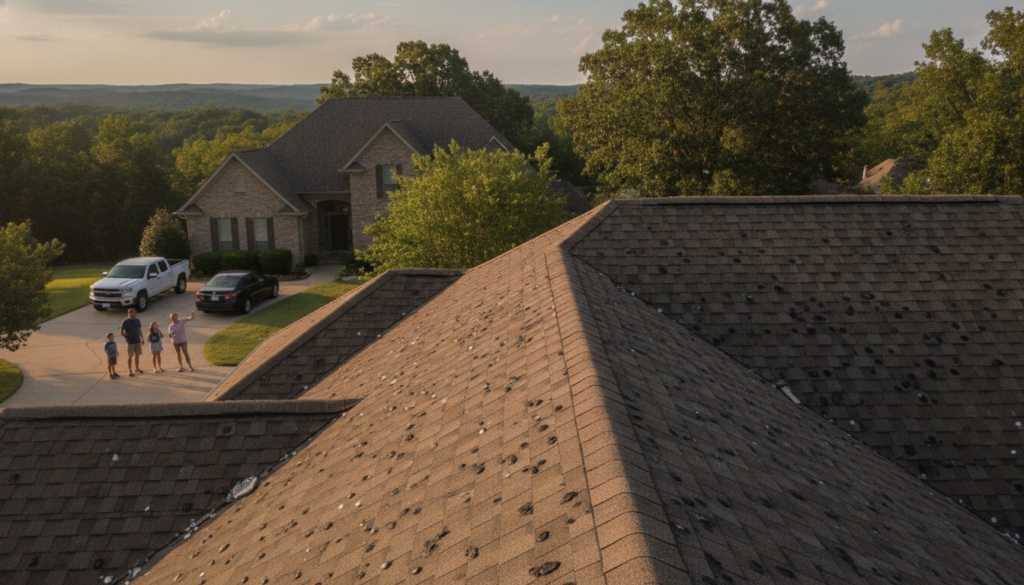
If you have lived in Central Arkansas for more than a season or two, you already know the sound. The sudden rattle on the roof. The ping against the gutters. Little white stones bouncing off the driveway. Hail is just part of life here, and it is not rare. Arkansas is one of the most active hail states in the country, with severe hail (one inch or larger) reported on roughly 32 days a year over a 30-year stretch. April and May alone account for nearly half of all hail reports, though a storm can roll through almost any month.
At the Victoria Payne Agency, we talk with families across Central Arkansas every spring who are trying to make sense of their home policy after a storm. The questions are almost always the same. Does my policy pay for a new roof? Why is my deductible so high? What are these new roof age rules I keep hearing about? This guide answers those questions in plain English, the way we would explain it to a neighbor sitting across our desk. The goal is to educate you, not sell you anything, so you walk into any coverage conversation already knowing the right questions to ask.
Why hail is such a big deal for Central Arkansas homeowners
Hail does not grab headlines the way tornadoes do, but it quietly causes an enormous amount of property damage every year. The reason comes down to geography and weather. Central Arkansas sits where warm, moist air from the Gulf collides with cooler air masses, and that collision creates the strong updrafts that build hailstones.
When we say severe hail happens on about 32 days a year across the state, that does not mean your specific neighborhood gets pelted that often. It means the odds of a given home being hit over a span of years are real and worth planning for. A single storm can drop stones large enough to bruise shingles, dent metal, crack vents, and knock the protective granules off an asphalt roof. Sometimes the damage is obvious. Often it is not visible from the ground at all, and that is one of the trickiest parts of dealing with hail.
Because this exposure is so common here, understanding your hail damage roof insurance Arkansas coverage is not a once-in-a-lifetime concern. It is worth revisiting every year or two, especially as your roof ages and as the rules around roof claims keep changing. A roof that was fully covered for replacement a few years ago may be treated differently today, and we will walk through exactly why.
What hail actually does to a roof
Hail damage falls into a few general buckets. There is cosmetic damage, like dents in soft metals and dings on siding, which may not threaten the roof but still matters. Then there is functional damage, which is what insurers care most about: bruising or fracturing of shingles, loss of the granules that shield the asphalt from the sun, and cracks that eventually let water in.
The sneaky part is that a bruised shingle can look almost normal from the street. The granules get knocked loose, the mat underneath weakens, and over the following months and years that spot degrades faster than the rest of the roof. By the time you see a leak in the ceiling, the storm that caused it may be long gone, which can make a claim harder to connect to a specific weather event. That is why acting promptly after a storm matters so much.
How hail damage roof insurance Arkansas coverage generally works
Start with the good news. A standard homeowners insurance policy in Arkansas generally covers damage caused by wind and hail. That coverage is one of the core reasons the policy exists in a state like ours. In most cases, your hail damage roof insurance Arkansas coverage reaches further than just the shingles overhead.
A typical homeowners policy is built around a few coverage parts, and hail can touch several of them:
- Dwelling coverage. This is the main structure of your home, including the roof itself. If hail damages your roof, this is usually the part of the policy that responds.
- Other structures coverage. Detached garages, sheds, carports, and fences often fall here. A hailstorm that beats up your backyard shed may be addressed under this portion.
- Personal property coverage. If hail punches through your roof or breaks a window and water or ice damages your belongings inside, this part may come into play.
None of this is automatic or guaranteed, and every policy has its own terms, limits, and exclusions. But as a general framework, this is how hail damage roof insurance Arkansas coverage tends to be structured. The specifics of your policy are spelled out in your declarations page and policy documents, and those are exactly the documents we like to review with people before a storm ever hits.
Covered events versus maintenance
One important distinction is between sudden storm damage and ordinary wear and tear. Insurance is designed to respond to sudden, accidental events like a hailstorm. It is not designed to replace a roof that has simply reached the end of its natural life. A 25-year-old roof that is curling and leaking because of age is a maintenance issue, not a hail claim.
This line matters because, as we will cover later, insurers sometimes point to normal aging to explain damage. Under Arkansas law, though, wear and tear is treated as a condition of the property, not an automatic reason to deny coverage for genuine storm damage. In other words, having an older roof does not, by itself, mean a legitimate hail claim should be refused. The question is whether the storm actually caused damage, not whether your roof happened to be old when it did.
The deductible surprise: percentage-based wind and hail deductibles
If there is one thing we wish every Central Arkansas homeowner understood before a storm, it is this. Many Arkansas policies carry a separate wind and hail deductible, and that deductible is often a percentage of your home’s insured value rather than a flat dollar amount. This detail catches more people off guard than any other, and it is central to understanding your hail damage roof insurance Arkansas coverage.
Here is how it works. A standard deductible might be a fixed amount that applies to most claims. But for wind and hail specifically, your policy may apply a separate percentage, commonly somewhere in the range of a small single-digit percentage of your dwelling coverage amount. Instead of a set figure, your out-of-pocket responsibility scales with how much your home is insured for.
A simple example of how the math changes
Let us walk through the kind of example we use at our desk. The percentage deductible is applied against your dwelling coverage amount, so the higher your home is insured for, the larger that out-of-pocket share becomes in actual dollars. The exact percentage on your own policy is printed on your declarations page, and multiplying it against your dwelling coverage tells you your real responsibility.
Compare that to someone who assumed their deductible was a flat, much smaller figure. The gap between the two can be substantial, and most people only discover it at the worst possible moment: right after a storm, when they are already stressed and trying to get their roof fixed. There is nothing hidden or improper about a percentage deductible. It is a common and legitimate structure in storm-prone states. The problem is simply that homeowners often do not realize it is there.
This is why we encourage people to pull out their declarations page and look for two things. First, is there a separate wind and hail deductible at all? Second, if there is, is it a percentage or a flat dollar amount, and what does that percentage work out to in actual dollars based on your current dwelling coverage? Knowing that number ahead of time removes the ugliest surprise from the entire process. Your hail damage roof insurance Arkansas coverage is far less stressful to use when you already know what your share of the cost will be.
Why the number can creep up over time
Here is a wrinkle worth noting. Because the deductible is a percentage of your insured value, it can quietly grow as your home’s replacement cost rises. Over the past several years, construction and material costs have climbed, and many policies automatically increase dwelling coverage to keep pace. That is generally a good thing, because you want enough coverage to actually rebuild. But a higher dwelling amount also means a higher dollar figure attached to that same percentage deductible. A policy review is the simplest way to stay on top of where that number currently sits.
Roof age rules and how hail damage roof insurance Arkansas coverage pays out
Now for the change that has generated the most questions in our office recently. As of 2024, and continuing through 2025, Arkansas has rules that affect how roof replacement is handled based on the age of your roof, and it directly shapes your hail damage roof insurance Arkansas coverage.
Here is the general shape of it. For roughly the first seven years of a roof’s life, roofs generally qualify for full replacement cost coverage, minus your deductible. In plain terms, if your newer roof is damaged by a covered hailstorm, the policy is generally designed to pay what it costs to put a comparable new roof back up, after you cover your deductible.
After that seven-year mark, insurers are permitted to apply depreciation schedules. Depreciation means the payout can be reduced to reflect the age and remaining useful life of the roof. A roof that is well past its first several years may be valued at its depreciated worth rather than the full cost of a brand new one. The older the roof, the larger that reduction can be.
Replacement cost versus actual cash value, in plain English
This gets at the difference between two ways a claim can be settled:
- Replacement cost aims to pay what it takes to replace the damaged item with a new one of similar kind and quality, without subtracting for age.
- Actual cash value starts from replacement cost and then subtracts depreciation for age and wear, which generally results in a smaller payout.
The seven-year roof rule in Arkansas is essentially a dividing line that influences which of these approaches may apply to your roof. A newer roof leans toward full replacement cost treatment. An older roof may be settled on a depreciated basis. This is why knowing the age of your roof is suddenly so important to your hail damage roof insurance Arkansas coverage. It is no longer just a maintenance detail. It is a number that can meaningfully affect what a claim pays.
What this means for you practically
A few takeaways we share with Central Arkansas homeowners:
- Know when your roof was installed. If you bought the home and are not sure, a roofing contractor or home inspector can often estimate the age, and prior owners or permit records may help.
- Understand that a timely claim matters. Damage reported and documented promptly after a storm is easier to tie to that event than damage discovered years later.
- Talk through your options before you need them. Some policies offer different ways to handle roof coverage. Those are choices to discuss with an agent based on your home, your roof’s age, and your budget, not something we would ever tell you to pick blindly.
We are not here to tell you which option is right for your family. We are here to make sure you understand how the roof age rules interact with your hail damage roof insurance Arkansas coverage so that whatever you choose, you are choosing it with your eyes open.
What to do right after a hailstorm in Central Arkansas
When a storm clears and the sun comes back out, there is a natural urge to grab a ladder and get up on the roof to see the damage. Please do not. The single most important thing we tell people is to prioritize safety and stay off the roof. Roofs are slippery after a storm, hail can leave surfaces unstable, and no claim is worth a fall. A proper inspection is the roofer’s job, and later the insurer’s job.
Instead, do a careful ground-level assessment. You can learn a surprising amount without ever leaving the yard. Here is what we suggest looking for:
- Dents on metal surfaces. Gutters, downspouts, metal roof edges, and the top and fins of your outdoor air conditioning unit are great hail indicators. Soft metal shows dings clearly.
- Granules in the downspouts or at the base of them. If you see little piles of sandy, gritty material washing out, those are the protective granules from your shingles, and that can be a sign of hail impact.
- Damaged or dented siding. Check the side of the house that faced the storm. Dents, chips, or cracks can point to a strong hail event.
- Cracked window frames, screens, or glass. These are easy to see and photograph from the ground.
- What the neighbors are doing. This sounds informal, but it is genuinely useful. If roofing crews are showing up on homes down the street, the same storm cell likely passed over your roof too.
Document, protect, but do not fully repair yet
If you suspect damage, the order of operations matters for your hail damage roof insurance Arkansas coverage:
- Document thoroughly. Take clear photos and video of everything you can safely see. Note the date of the storm. Keep any debris that illustrates the damage if it is safe to do so.
- Contact your agent promptly. Reach out to our team at the Victoria Payne Agency so we can help you understand your coverage and the claim process. The sooner the better, both for documentation and for the roof-age timing we discussed earlier.
- Make temporary repairs to prevent further damage. If water is getting in, it is reasonable and expected to tarp a leak or board a broken window to stop the situation from getting worse. Keep receipts for those temporary measures.
- Hold off on permanent repairs. Do not have the full roof replaced or permanent repairs completed until your insurer has inspected the damage and there is agreement on the scope of the work. Permanent repairs done too early can remove the evidence the adjuster needs to see.
That last point trips people up. We understand the instinct to just get it fixed and move on. But jumping straight to a full replacement before the inspection can genuinely complicate your hail damage roof insurance Arkansas coverage, because the adjuster can no longer evaluate what was actually there. Temporary protection first, permanent repair after agreement. That sequence protects both your home and your claim.
A word on storm-chasing contractors
After any significant hail event in Central Arkansas, out-of-town roofing crews often appear going door to door. Some are perfectly reputable. Others are not. We simply encourage people to be cautious, verify licensing and local references, never sign anything that assigns away your insurance rights without understanding it, and feel free to call us if a contractor is pressuring you to make a fast decision. A legitimate professional will not mind you taking a day to think and to loop in your agent.
When a hail claim gets denied, delayed, or underpaid
Most hail claims in Arkansas are fairly straightforward. A storm hits, damage is documented, an adjuster inspects, and the claim moves forward within the terms of the policy. But it would not be an honest guide if we pretended every claim goes smoothly. Some hail claims do get denied, delayed, or paid at less than the homeowner expected, and it helps to understand both why that happens and what protections exist.
The wear and tear question
One of the most common friction points involves granule loss and shingle condition. An insurer may look at a roof and suggest that the granule loss or shingle wear is the result of normal aging rather than the hailstorm. This is where that Arkansas principle we mentioned earlier becomes important. Wear and tear is a condition, not a standalone reason to deny coverage for storm-related damage.
In practical terms, the fact that your roof had some age on it does not automatically convert genuine hail damage into an uncovered maintenance problem. If a storm caused functional damage, the age of the roof affects how the payout is calculated under the depreciation rules, but it should not be used as a blanket excuse to wave off real storm damage. Good documentation, dated to the storm, is your best friend in sorting out that distinction.
Protections for Arkansas policyholders
Arkansas law does provide protections for homeowners when an insurer fails to pay a valid claim. Those protections can include financial penalties and attorney’s fees in situations where a legitimate claim is wrongly refused. We are not attorneys, and nothing here is legal advice, so we will keep this general. The point is that the system is not one-sided, and a valid claim has real backing behind it under state law.
If your claim is denied or you believe it was underpaid, a few sensible steps apply:
- Read the written explanation carefully. Insurers generally must tell you why a claim was handled the way it was.
- Gather and organize your documentation, including your storm-dated photos, any contractor assessments, and your temporary repair receipts.
- Ask questions. You are entitled to understand the reasoning behind a decision, and you can request a re-inspection in many cases.
- Call us. As your local agency, we can help you understand what the paperwork is actually saying and what your next options are within the process.
Understanding your hail damage roof insurance Arkansas coverage before a dispute arises makes these moments far less overwhelming. When you already know how your deductible works, how roof age affects your payout, and how the claim process is supposed to flow, a bump in the road feels manageable rather than mysterious.
Keeping your hail damage roof insurance Arkansas coverage current
Insurance is not a set-it-and-forget-it product, especially in a state with as much weather as ours. The home you insured five years ago may cost more to rebuild today. Your roof is five years older than it was. The rules around roof replacement have shifted. All of these moving parts mean your coverage can drift out of alignment with your actual situation without you ever noticing.
This is why we are big believers in regular policy reviews. A review is simply a conversation where we look at your current policy together and check whether it still fits. Some things worth revisiting:
- Dwelling coverage versus rebuild cost. Does your coverage amount still reflect what it would actually cost to rebuild your home at today’s construction prices? This also affects the dollar value of a percentage deductible.
- Your wind and hail deductible. Do you know whether it is a percentage or flat amount, and what that works out to in real dollars right now?
- Roof age and replacement cost treatment. Where does your roof sit relative to the seven-year line, and how does that affect how a future claim might pay?
- Changes at home. New additions, a finished garage, a renovated kitchen, a new detached shop, or valuable belongings can all change what you need.
A composite example of why reviews matter
Consider a scenario drawn as a composite of the kinds of households we work with across Central Arkansas, not any single real family. Picture a couple who bought their home several years ago, insured it, and never thought about the policy again. Over those years, rebuild costs rose, so their dwelling amount automatically increased. Their roof quietly aged past the seven-year point. When a spring hailstorm finally hit, they were surprised twice: once by a percentage deductible that was now a bigger dollar figure than they realized, and again by depreciation on the older roof.
Nobody did anything wrong here. It was simply a policy that had never been revisited to match a changing situation. A single review conversation a year or two earlier would have surfaced all of it, and the couple could have made informed choices ahead of the storm. That is the entire value of understanding your hail damage roof insurance Arkansas coverage in advance rather than in a scramble afterward.
Putting it all together
Hail is a permanent feature of life in Central Arkansas. We cannot stop the storms, but we can make sure you are not caught off guard by how your coverage responds to them. The big ideas are worth repeating in one place:
- Standard homeowners policies in Arkansas generally cover wind and hail damage to your dwelling, other structures, and belongings, within the terms of the policy.
- Many Arkansas policies carry a separate wind and hail deductible that is a percentage of your insured value, which can mean a much larger out-of-pocket share than people expect.
- Roof age matters more than ever. Roofs generally qualify for full replacement cost for about the first seven years, after which depreciation schedules may reduce the payout.
- After a storm, stay safe and off the roof, assess from the ground, document everything, make only temporary repairs, and contact your agent before any permanent work.
- Arkansas law offers protections for policyholders when a valid claim is wrongly denied, and wear and tear alone is not a blanket reason to refuse storm damage.
- Regular policy reviews keep your coverage, your deductible, and your roof-age situation aligned with reality.
Our team at the Victoria Payne Agency serves families, homeowners, and small business owners across Central Arkansas and the surrounding communities, and we genuinely enjoy helping people understand this stuff before they ever need it. If you are unsure how your current hail damage roof insurance Arkansas coverage would respond, or you just want someone to walk through your declarations page with you in plain English, we are glad to sit down and talk through your options together. No pressure, no jargon, just a clear picture of where you stand so you can decide what is right for your home.
Frequently asked questions
Does homeowners insurance in Arkansas cover hail damage to my roof?
A standard homeowners policy in Arkansas generally covers damage caused by wind and hail, including damage to your roof, within the terms of your specific policy. Coverage can also extend to other structures and personal belongings if hail penetrates your roof or windows. The exact limits and conditions are spelled out in your policy documents, so it is worth reviewing them with an agent.
What is a percentage-based wind and hail deductible in Arkansas?
Many Arkansas policies apply a separate wind and hail deductible calculated as a percentage of your home’s insured value, rather than a flat dollar amount. You multiply that percentage against your dwelling coverage to find your actual out-of-pocket responsibility before coverage responds. Because it scales with your coverage amount, it can be larger than homeowners expect. Your exact percentage is printed on your declarations page.
How does the age of my roof affect a hail claim in Arkansas?
As of 2024 and through 2025, roofs in Arkansas generally qualify for full replacement cost coverage for roughly the first seven years, minus your deductible. After seven years, insurers are permitted to apply depreciation schedules that can reduce the payout based on the roof’s age. Knowing when your roof was installed helps you understand how a future claim might be settled.
What should I do right after a hailstorm hits my Central Arkansas home?
Stay safe and off the roof, then do a ground-level assessment looking for dents on gutters and your AC unit, granules in downspouts, damaged siding, and cracked windows. Document everything with photos, contact your agent promptly, and make only temporary repairs to prevent further damage. Avoid permanent repairs until the insurer has inspected the damage and the scope of work is agreed upon.
Can an insurer deny my hail claim just because my roof is old?
Under Arkansas principles, wear and tear is treated as a condition of the property, not an automatic reason to deny coverage for genuine storm damage. An older roof may affect how depreciation is calculated, but age alone should not be used as a blanket excuse to refuse legitimate hail damage. Arkansas law also provides protections for policyholders when a valid claim is wrongly denied.
How often should I review my hail and roof insurance coverage?
Reviewing your policy every year or two is a smart habit, especially in a storm-prone area like Central Arkansas. Rebuild costs, your roof’s age, your deductible structure, and state rules can all change over time and shift your coverage out of alignment. A review conversation helps you understand your options and avoid surprises before a storm hits.
Sources
- Home Insurance in Arkansas – Victoria Payne Agency
- Arkansas Hail Season: How Often and How Big – MyWild
- Arkansas Homeowners Insurance Guide: Coverage, Costs, And Options
- Arkansas Home Insurance Guide
- Complete Guide to Filing Hail Damage Claims in Arkansas – Ozk Insurance
- Wind & Hail Deductible Arkansas: The Number You Don’t Know – Cribb Insurance Group