
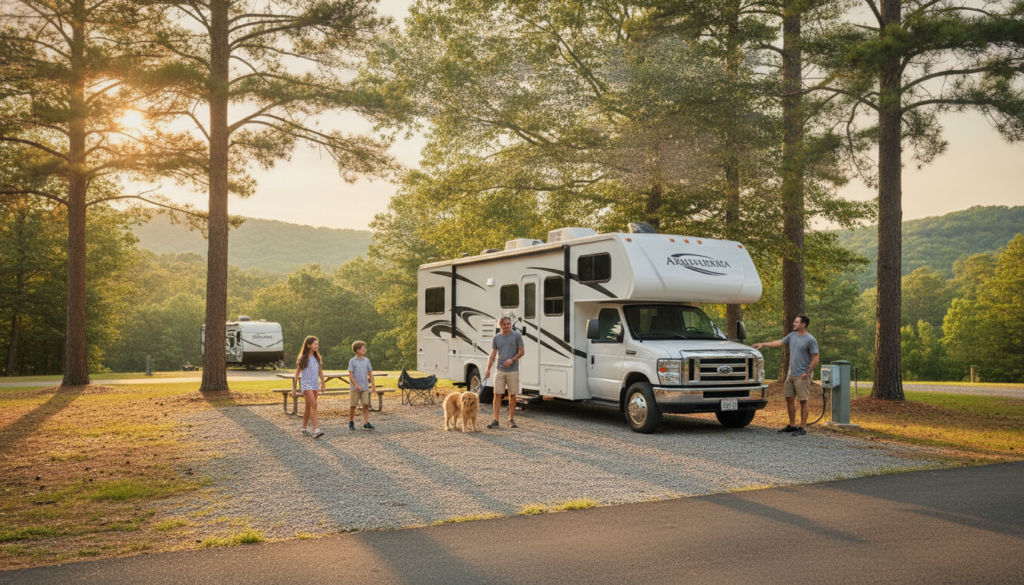
Own an RV in Central Arkansas, or thinking about buying one? Then you have probably hit a wall of terms, requirements, and fine print. Motorhome. Travel trailer. Fifth wheel. Liability, comprehensive, vacation liability, full-timer’s coverage. It is a lot to sort through before you ever point the rig toward Petit Jean, the Buffalo River, or a weekend at Lake Ouachita.
We put this guide together to make it simple. Our team at Victoria Payne Agency works with families and travelers all over the region, and the question we hear most often boils down to one thing: what does my RV policy actually do for me? This is a plain explainer, written the way a neighbor would explain it over the fence. Not the way a legal document would.
By the end, you will know what Arkansas requires, what each coverage protects, and which options are worth a conversation. We will not quote you a price or tell you what to buy. We will give you the background so you can make a confident decision when you talk through RV insurance coverage Arkansas owners rely on.
Why RV insurance coverage Arkansas owners need depends on the type of RV
Start here: “RV” is a big umbrella. The term covers everything from a van-sized Class B camper to a 40-foot Class A motorhome, and it also includes towables like travel trailers, pop-up campers, and fifth wheels. The kind of RV you own changes what the law requires and what kind of policy makes sense.
Here is how we break it down for folks:
- Motorized RVs (motorhomes). These drive themselves. Think Class A, the big bus-style coaches. Class B, the camper vans. Class C, the ones with the cab-over bunk. Because they are self-propelled vehicles on public roads, the state treats them much like a car when it comes to insurance.
- Towable RVs. No engine. Travel trailers, fifth wheels, and pop-up campers all get pulled behind a truck or SUV. Because they do not drive themselves, the state treats them differently, which surprises a lot of new owners.
Why does the distinction matter so much? Because the type of RV determines whether a separate policy is legally required, how liability flows while you are driving, and what happens to the physical structure of your RV if a storm, a tree limb, or an accident damages it. Getting this part right is the foundation of understanding RV insurance coverage Arkansas drivers and campers actually need.
Motorhomes are treated like other motor vehicles
Own a motorhome, and Arkansas law requires you to carry minimum liability insurance, same as on your car or truck. A motorhome is a motor vehicle in the eyes of the state, so it has to meet the same baseline before it legally runs on public roads.
Towable RVs ride on your tow vehicle’s liability, up to a point
Own a travel trailer or fifth wheel, and state law generally does not require a separate policy for the trailer itself. While you are towing it, the liability coverage from your auto policy on the towing vehicle typically extends to the trailer. That sounds convenient, and in some ways it is. There is an important catch we will come back to, though: that extended liability does not protect the trailer itself from physical damage.
What Arkansas actually requires for RV insurance coverage
Let’s get specific, because this is where a lot of the confusion lives. We will keep it to what applies in Arkansas so you are not guessing.
Minimum liability limits for motorized RVs
For self-propelled RVs, meaning your Class A, B, and C motorhomes, Arkansas requires the same minimum liability limits that apply to other motor vehicles. Those limits are:
- $25,000 for bodily injury per person
- $50,000 for bodily injury per accident
- $25,000 for property damage per accident
You will often see those three numbers written as 25/50/25. That is the floor. It is the least liability protection the law allows you to carry on a motorhome. Many owners choose higher limits, since an RV is large, valuable, and can cause real damage in an at-fault accident. The decision on limits is one to talk through based on your situation.
Uninsured and underinsured motorist and PIP in Arkansas
Arkansas also addresses two other coverages that come up with motorized vehicles. The state mandates uninsured and underinsured motorist (UM/UIM) bodily injury and property damage coverage, and it mandates personal injury protection (PIP). The nuance that matters: Arkansas lets you reject or lower these coverages in writing. So they are part of the standard framework, but you have choices about how much to carry.
We will explain what each of these actually does a little further down, because the names are not exactly friendly English. For now, just know they are part of the picture when we talk about RV insurance coverage Arkansas motorists put in place.
What the law does not require (but your lender might)
Here is the part that trips people up. For a towable RV, the state generally does not require a separate policy. And even for a motorhome, the state minimum only addresses liability, not damage to your own RV.
Legal minimums and real-world requirements are two different things, though. If you finance or lease your RV, motorized or towable, your lender almost always requires comprehensive and collision coverage. The lender has money tied up in that RV, and they want it protected until the loan is paid off. So even if the state does not require physical damage coverage, your loan paperwork very likely does.
The short version: Arkansas sets a liability floor for motorhomes, treats towables differently, and leaves physical damage protection mostly up to you and your lender. That gap is exactly why it helps to understand the optional coverages before you decide.
The core coverages inside RV insurance coverage Arkansas policies
Now for the heart of it. When people ask us what RV insurance covers, these are the building blocks. Think of them like ingredients. You and your agent decide which ones go into your policy and in what amounts. We are describing what each one does, not telling you which to pick.
Liability coverage
Liability pays for injuries or property damage you cause to other people when you are at fault. If your motorhome rolls into another vehicle at a stoplight, or you cause a crash that injures someone, liability coverage responds to the other party’s bodily injury and property damage. It does not pay to fix your own RV. It is about the harm you cause to others.
This is the coverage the state requires on motorhomes, and it is the piece of your auto policy that typically extends to a trailer while you are towing it.
Collision coverage
Collision covers the cost of repairing or replacing your RV after an accident with another vehicle or an object, no matter who was at fault. Backed into a concrete post at a gas station? Clipped a guardrail on a tight mountain road? Collision is the coverage that addresses damage to the physical structure and the built-in features of your RV. For motorhomes, that structure is a big investment, and for a fifth wheel it is often the single most expensive thing in the driveway.
Comprehensive coverage
Comprehensive is the one that matters a lot here in Arkansas, so pay attention. It protects your RV from damage caused by things other than a collision. That includes:
- Theft and vandalism
- Fire
- Falling objects, like a tree limb coming down in a storm
- Severe weather, including hail and flooding, both of which Arkansas sees
- Hitting an animal, such as a deer
Spend a spring in Central Arkansas and you know how fast a storm can roll through. Hail can hammer a parked RV. Straight-line winds can bring down branches. Flooding is a real exposure in low-lying areas. Comprehensive coverage is what responds to those non-collision losses. When we talk with local owners about RV insurance coverage Arkansas weather makes relevant, comprehensive is usually front and center.
Uninsured and underinsured motorist coverage
UM/UIM coverage helps when the other driver is at fault but either carries no insurance or does not carry enough to cover the damage they caused. If an uninsured driver hits your motorhome and injures your family, your own UM/UIM coverage can step in to help with those expenses. As we mentioned, Arkansas mandates UM/UIM bodily injury and property damage, with the option to reject or lower it in writing.
Medical payments and personal injury protection
Medical payments coverage and PIP help pay for medical expenses, and in some cases lost wages, for you and your passengers after an accident, regardless of who was at fault. Arkansas mandates PIP, and like UM/UIM, you may reject or lower it. The appeal is simple: it responds to injuries without waiting to sort out blame, which can matter when you are far from home on a trip.
The RV-specific coverages that make RV insurance coverage Arkansas travelers want
Here is where RV policies get interesting and where they go beyond what a regular auto policy offers. An RV is not just a vehicle. It is also, at times, a home, a storage unit, and a campsite. These coverages address that reality.
Personal effects and personal property coverage
You keep a lot of stuff in an RV. Clothes, electronics, camping gear, kitchen supplies, outdoor equipment, maybe some fishing rods for a trip to the lake. Personal effects coverage reimburses you for those belongings if they are damaged or stolen. A standard auto policy generally will not treat your travel trailer like a closet, so this is one of the coverages that makes an RV policy feel purpose-built.
Vacation liability
This one is easy to overlook and genuinely important, especially for towable RVs. Remember how your auto liability extends to a trailer while you are towing it? Once you unhitch and set up camp, that towing situation is over. Vacation liability provides liability protection if someone is injured in or around your RV or campsite while it is parked and being used as a temporary residence.
Picture a composite of the camping families we work with. They pull into a campground near a lake, level the fifth wheel, roll out the awning, and set up chairs. A guest trips over the step and gets hurt. Vacation liability is the coverage designed for that moment, when the RV is a home base rather than something you are hauling down the highway. A lot of Arkansas campers do not know this coverage exists.
Total loss replacement
For qualifying newer RVs, total loss replacement coverage can replace a totaled RV with a brand new one of a similar make and model, rather than paying out the depreciated value. RVs can lose value quickly in the early years, so for a new purchase, this option changes the math on a total loss. Whether your RV qualifies depends on the specifics, which is a good thing to ask about.
Emergency expense coverage
If your RV breaks down or becomes disabled due to a covered loss while you are a certain distance from home, often around 50 miles, emergency expense coverage can help pay for unexpected costs like lodging and alternative transportation. The whole point of an RV is to be far from home, so being stranded is exactly the scenario where this helps. It keeps a bad day from turning into a bad week.
Roadside assistance
Roadside assistance covers the ordinary roadside problems that get a lot bigger when you are driving something the size of a bus. Flat tires, dead batteries, and towing all fall here. Towing a motorhome is not the same as towing a sedan, so having a plan built for RVs is worth considering.
Full-timer’s coverage
If you live in your RV for more than about six months of the year, full-timer’s coverage offers broader protection that looks more like a homeowner’s policy. It includes personal liability while the RV is parked and used as a residence, which is a different exposure than recreational use. Arkansas has a growing number of full-time RV residents, and if that is your lifestyle, this is a very different conversation than insuring a weekend camper. It is one of the more specialized pieces of RV insurance coverage Arkansas residents ask us about.
Pet injury coverage
Plenty of RVs travel with a dog or a cat along for the ride. Pet injury coverage helps cover veterinary bills if your pet is hurt in a covered RV accident. For families who treat their animals like members of the household, this is a small addition that brings real peace of mind.
Pest damage protection
Rodents, insects, and other critters can do surprising damage to an RV, especially one that sits parked for stretches between trips. Standard policies often exclude this kind of damage, but pest damage protection can cover repairs when vermin get in and chew through wiring or insulation. If your RV spends the off-season parked at home or in storage, this is worth knowing about.
Roof protection
An RV roof takes a beating from sun, weather, and time. Some coverage options, sometimes branded as roof protection plans, may pay to repair or replace a damaged RV roof, and for eligible RVs may even address normal wear and tear. A roof repair can be a major expense, so this is another option some owners choose to explore.
Arkansas risks that shape RV insurance coverage decisions
We always try to connect coverage back to real life here in Central Arkansas, because the risks you face shape which coverages matter most to you. These are the exposures we talk about again and again with local RV owners.
Severe weather, hail, and flooding
Arkansas weather is no joke. Spring and summer bring hail, high winds, and heavy rain, and parts of our region sit in areas prone to flooding. An RV parked in a driveway or at a campsite is exposed to all of it. Hail can dent a roof and crack skylights. Wind can drop a limb on the whole rig. Floodwater can ruin everything inside. Comprehensive coverage is the piece that responds to these non-collision weather losses, which is why we spend real time on it when we discuss RV insurance coverage Arkansas storms make so relevant.
Wildlife collisions
Deer are everywhere in rural Arkansas, and they do not check for oncoming traffic. A collision with a deer or other animal can cause serious damage to the front of a motorhome. Hitting an animal is generally handled under comprehensive coverage, not collision, which surprises some folks. If you drive country roads at dawn or dusk, this is a very real exposure to keep in mind.
Rural and backroad driving
Getting to the good spots in Arkansas often means narrow roads, tight turns, low branches, and gravel. Maneuvering a large RV in those conditions raises the odds of a scrape, a backing accident, or a run-in with a fixed object. Collision coverage is what addresses damage to your own RV in those at-fault, no-other-driver situations.
Long-distance and off-season storage
Many Arkansas RVs sit parked for months at a time between seasons. That downtime creates its own risks: theft, vandalism, pests, and weather damage while the RV is not in use. Comprehensive coverage, along with options like pest damage protection, speaks directly to the parked-and-waiting part of RV ownership.
What affects the cost of RV insurance coverage Arkansas owners pay
We will not quote prices here, and we would be skeptical of anyone who gives you a number before learning anything about your situation. What we can do is explain the honest factors that go into how RV insurance is priced, so there are no surprises when you request a quote.
- Type and class of RV. A Class A motorhome, a camper van, and a travel trailer are very different animals, and they are rated differently.
- Make, model, and value. A newer, more valuable RV carries more risk than an older, modest one.
- How you use it. Recreational, occasional use is a different exposure than full-time living. Full-timers generally need broader coverage, which factors in.
- Your driving record. As with auto insurance, your history on the road is part of the picture.
- Coverage limits and deductibles. The amount of protection you choose and how much you are willing to pay out of pocket on a claim both play a role.
The combination of these factors is unique to you, which is exactly why a quick conversation beats a guess. Once you understand the pieces, you can make smart choices about where to carry more protection and where you are comfortable with less.
How to think through your own RV insurance coverage Arkansas needs
Let’s bring it all together with a simple way to think about your own situation. You do not need to memorize every coverage name. You just need to answer a few plain questions.
Motorhome or towable?
If it drives itself, you are legally required to carry at least the state minimum liability. If it is towed, your auto liability extends while you are hauling it, but the trailer itself has no physical damage protection unless you add it.
Do you owe money on it?
If you financed or leased the RV, your lender almost certainly requires comprehensive and collision. That decision may already be made for you, and that is fine, because those are the coverages that protect the RV itself.
Where and how do you use it?
Weekend trips to a nearby lake are a different exposure than crossing the country or living in the RV full-time. The more you use it, the farther you go, and the longer you stay, the more coverages like vacation liability, emergency expense, roadside assistance, and full-timer’s coverage come into the conversation.
What would hurt the most to lose?
Think about the gear inside, the roof overhead, the pet in the passenger seat, and the storms that roll through every spring. That reflection usually points you toward which optional coverages are worth exploring, from personal effects to comprehensive to pest and roof protection.
There is no single right answer, and there is no coverage we would ever tell you that you must buy. The goal is to match your policy to how you actually live and travel, so you are protected where it counts and not paying for things that do not fit your life.
If you are weighing RV insurance coverage Arkansas options and want a straightforward conversation with people who know the region, our team at Victoria Payne Agency is glad to walk through it with you. We will help you understand your choices, answer your questions in plain English, and build something that fits your adventures. Reach out whenever you are ready, and we will take it from there.
Frequently asked questions
Is RV insurance required in Arkansas?
Motorized RVs like Class A, B, and C motorhomes are legally required to carry minimum liability insurance in Arkansas, same as other motor vehicles. Towable RVs such as travel trailers generally are not required to have a separate policy, because your auto liability typically extends while you tow them. If you finance or lease any RV, though, your lender almost always requires comprehensive and collision coverage.
What are the minimum RV insurance requirements in Arkansas?
For motorized RVs, Arkansas requires minimum liability limits of $25,000 for bodily injury per person, $50,000 for bodily injury per accident, and $25,000 for property damage per accident. The state also addresses uninsured and underinsured motorist coverage and personal injury protection, which you may reject or lower in writing. These are starting points, and many owners choose to discuss higher limits.
Does RV insurance cover hail and storm damage in Arkansas?
Hail, wind, falling tree limbs, and other severe weather damage are generally covered under comprehensive coverage, not liability or collision. Because Arkansas sees real hail and storm exposure in spring and summer, comprehensive is a coverage many local RV owners talk through carefully. Flooding is also typically addressed under comprehensive coverage.
What is vacation liability on an RV policy?
Vacation liability provides liability protection if someone is injured in or around your RV or campsite while it is parked and being used as a temporary residence. This matters especially for towable RVs, because your auto liability only extends while you are actively towing. Once you unhitch and set up camp, vacation liability is the coverage designed for that situation.
Does my car insurance cover my travel trailer in Arkansas?
While you are towing a travel trailer, the liability coverage from your towing vehicle’s auto policy typically extends to the trailer. That extended liability does not protect the trailer itself from physical damage like theft, hail, fire, or an accident, though. To protect the trailer’s structure and your belongings inside, you would need to add coverage specific to the RV.
What does full-timer’s RV coverage mean?
Full-timer’s coverage is a specialized option for people who live in their RV for more than about six months of the year. It offers broader protection similar to a homeowner’s policy, including personal liability while the RV is parked and used as a residence. Because full-time living is a different exposure than recreational use, it is worth a dedicated conversation with an agent.
Sources
- Arkansas RV Insurance | Progressive
- Buy RV/Camper Insurance in Arkansas – Roamly
- A Guide to Full-Time RV Living in Arkansas – RVshare
- Affordable RV Insurance in Arkansas | Fast Quote in Minutes
- Motorhome Insurance – Springdale AR & Fayetteville AR – Walker Brothers Insurance
- Motorhome & RV Insurance | Mountain Home, AR | Baxter